Showing posts with label Books. Show all posts

Friday, January 17, 2014

Little Friend

Axel, 2014


Well, so far we've survived a week on our own.

Here's Axel, helping me make the bed this morning. He's been a good egg all week, even waking up a couple of mornings around 8:30, after moi. He's newly taken with a book called Quack Like  a Duck and wants me to read it to him umpteen times in a row (but mainly just to talk about ducks 24-7.) But his papa is back tomorrow morning and I am sure that will be a source of major excitement. Ducks, who?

It's just dawning on me that we have 40-ish days left as a family of three, and as much as I can't wait to meet our new arrival, I am antsy for Will to get back so that we can enjoy this time together.

Thursday, December 5, 2013

School Daze

via Amazon

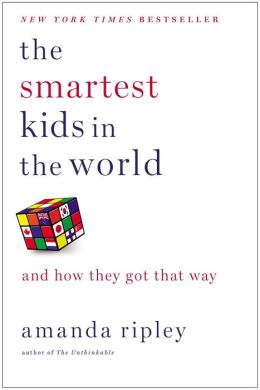
So I just finished reading The Smartest Kids in the World. The title is a bit of an oversell, but the concept is this: There's an international exam called the PISA, and American kids do terribly on it compared with children from the top three countries: Finland, Korea, and Poland.

I can't remember our exact ranking, but it's somewhere in the twenties. Even affluent American kids fare worse than their counterparts in these countries and whatever you think about testing, the results are still pretty striking. Another interesting point is that upper middle class kids fare about the same on the test whether they go to private or public school, and the countries that have the top rankings spend far less than America does per student.

I know Axel is only 15 months old (until tomorrow!), but I've been thinking about schools a lot lately and even touring a few public and private options. I went to private school from nursery through high school, and I loved my very Harry Potter-esque school experiences. I think my schools served me well and fostered my love of learning. But since I attended school, the cost of private school tuition has seriously outpaced inflation, and in New York can be as much as $40,000 a year. For pre-school.

Of course, there are some slightly more affordable local options in Brooklyn, but I'm a long term planner, and I wanted to know what the real differences were between the private and public schools we'd likely choose, so I've been dutifully checking them out in person.

So far, what I've seen hasn't given me total clarity on the subject. The private schools seemed more play-based, with little wooden kitchens, and teachers who had MAs in English or the fine arts. There was a lot of discussion of projects and multi-disciplinary learning as well as an emphasis on things like music, recess, the arts and field trips. The public schools nearby have been a little more grim, aesthetically speaking, as well as more die hard about following a set curriculum, with 5-year-olds hunched over work sheets and teachers using lots of jargon. From what I can gather, though, they are improving, have involved PTAs, and might be okay for elementary school.

It's hard for me to really parse what I'm seeing or to understand the public schools' grading systems, since I'm not sure how much significance I want to place on testing for kids under the age of, say, ten. And I can't help but wonder if supplementing school with extracurricular activities like music or art would help. Couldn't you sort of cobble together the ideal education with lots of extra help at home?

Of course, these are economic decisions, especially with a second child on the way. I'd love to have faith in our local schools, and in public education as a whole, but this book just prompts more questions!

Tuesday, May 1, 2012

Modern Motherhood

France, 2009


An interesting piece over at Salon on whether modern, "naturalist" mothering (natural birth, co-sleeping, breastfeeding, cloth diapering) actually marks a step backwards for women.

Writer Madeline Holler, who home birthed, breastfed, and cloth diapered her babies (before ultimately quitting her job to spend more time with them in their infancy), explains how her mother did it all so very differently in order to maintain her hard-won career and wonders who had it right.

She also cites a book by feminist Elisabeth Badinter, The Conflict: How Modern Motherhood Undermines the Status of Women, which makes the case that modern mamas' obsession with doing everything naturally makes their lives exceedingly more difficult and handicaps them in other areas of life, like work.

It hits a cord with me, not least because I am contemplating going back to an office.

Lately I've read a few really heartbreaking blog posts from women who struggled with breastfeeding, and who felt like total failures when they had to switch to formula. I've spoken to other mothers who feel that having a nanny is tantamount to child abuse, or who feel that if they get an epidural during labor they are somehow less than.

There just seems to be so much guilt and grief over these topics, when in reality, as long as a baby is safe and well loved, is it really worth all the psychic drama? Of course I intend to breastfeed if I can, am curious about natural birth (even if I draw the line at co-sleeping and cloth diapering.)  But I do feel, to a certain extent, that that voice in womens' heads that says it-doesn't-count-unless-it's-100%-organic-painful-and-bloody-hard is kind of counter-productive.

Monday, April 9, 2012

The Latest

New York, 2012
New York, 2012

Had a regular doctor's checkup (all fine in babyland) and then walked up through Soho to Union Square for a few errands today.

Got home and put my feet up. Saw baby's thumps from the outside for the first time. Some days are much more active than others, but I am definitely feeling some action every day now.

Also got a kick out of (ha, get it!) this week's New Yorker. One article, "The Case Against Kids" cites the book Selfish Reasons to Have More Kids, by Bryan Caplan.

The piece explains his thinking: "Kids are a pain in the ass when they're small. They require lots of care just at the time their parents tend to be busiest establishing themselves in their careers. As a result, most people stop producing children before they've reached the number that would, over the long haul, maximize their self-interest."

Caplan asserts that the perfect number of children (short term pain versus long term gain) is three. He also argues that genes trump environment, so once you have the the kids in the bag, you don't have to worry as much as you might think about being the perfect alpha parent. Chances are, he says, they'll be just fine.

As an only child, I've always been envious of large families, and Will, one of four, loves the idea of a tribe. So is 3 the magic number?

Sunday, March 4, 2012

Book Club

Koh Samuii, Thailand, 2009

There's a piece up on Babble about how Japanese school teachers let children resolve their own playground conflicts, without stepping in to say "Be nice" or "Don't hit." The article is excerpted from a new book called How Eskimos Keep Their Babies Warm: And Other Adventures in Parenting (from Argentina to Tanzania and everywhere in between.)

While some parenting "philosophies" pop up around the globe, it's the differences I find fascinating.

Will and I have nieces and nephews being raised in England and in Singapore (a former British trading post), where strict scheduling is generally valued...at least by the parents we know. Our little guy will be raised in urban Brooklyn, where, as I've mentioned, different theories abound. Then there's the whole French mother debate.

What's amazing is how militant each camp can be, saying things like, "If you don't put your baby to bed at 7 on the dot, he'll grow up to be a juvenile delinquent." Or, "Letting your baby cry it out will cost thousands in therapy later on." Well, not exactly, but you know what I mean...

I kind of prefer the patchwork approach. Guess I'll go see what I can glean from those Eskimo mamas.
Related Posts Plugin for WordPress, Blogger...